Zigbee vs Wi-Fi for Smart Home in Pattaya
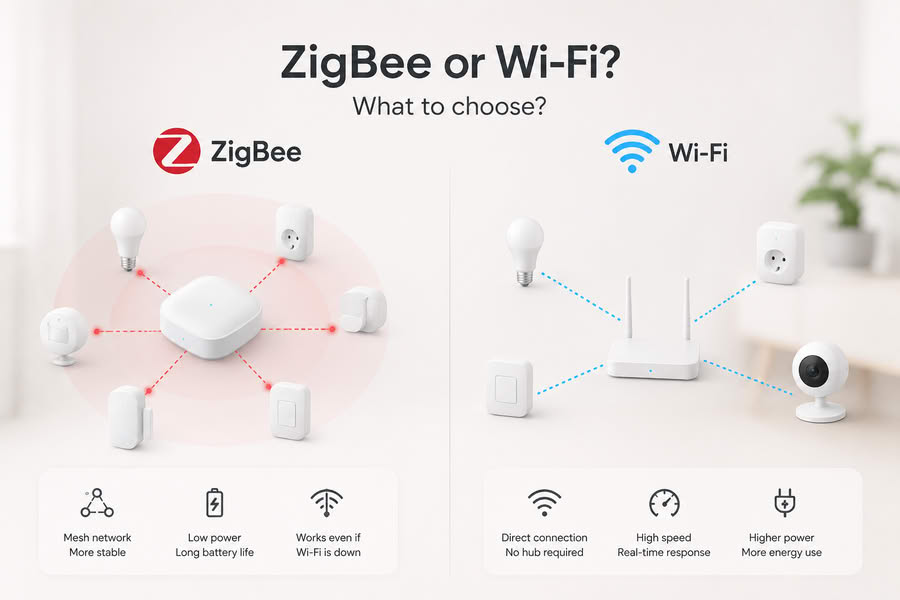
When building a smart home, it is important to choose the right type of devices. Wi-Fi devices look simple: connect them to the router, add them to the app and start using them. But when the number of devices grows, the network can become overloaded.
Zigbee works differently. Devices connect not directly to the router, but through a Zigbee coordinator or gateway. This reduces the load on the Wi-Fi network and makes the system more stable, especially in villas, large houses, condos and properties with many sensors.
Choose equipment before buying devices
Send the property type, device count, current router, desired automations and whether local operation without internet is important.
Installed starter options
- three Tapo P110M Wi-Fi smart plugs with energy monitoring: 2,500 THB;
- Sonoff Zigbee Bridge Pro with setup and up to five existing compatible devices: 2,500 THB;
- Bridge Pro with door, motion and leak sensors: 4,500 THB;
- Home Assistant Green Local Zigbee Core with coordinator: 22,900 THB.
These are complete installed starting points, not unexplained labour charges. Each quote states the physical equipment and included setup.
When Wi-Fi is practical
Wi-Fi can be suitable for a small number of powered devices such as smart plugs, selected lamps, cameras or appliances with a reliable local or cloud integration. It avoids a separate radio gateway, but every product still needs good coverage, credentials and an acceptable dependency model.
When Zigbee is practical
Zigbee is usually a better starting point for multiple battery sensors, buttons, lighting relays and wall switches. Devices join a coordinator or gateway instead of receiving individual Wi-Fi connections. A well-planned mesh can expand through suitable powered routing devices.
Direct comparison
- Hub: Zigbee needs a coordinator or gateway; Wi-Fi uses the IP network.
- Battery: Zigbee is commonly suitable for low-power sensors.
- Coverage: Zigbee needs mesh planning; Wi-Fi needs correctly placed access points.
- Local operation: depends on the exact platform and device, not only the radio name.
- Compatibility: every model and required function must be checked.
A mixed system is often correct
A property can use Ethernet for the server and access points, Zigbee for sensors and switches, and Wi-Fi for selected plugs or appliances. The objective is not to declare one protocol the winner; it is to keep the system supportable and avoid unnecessary accounts, gateways and network congestion.
Cloud dependency is a separate decision
Some Wi-Fi devices provide local control, while others require the manufacturer cloud. Zigbee devices communicate locally with their coordinator, but a proprietary gateway app may still use cloud services. We document the selected architecture instead of assuming that Zigbee automatically makes every function private or offline.
Planning and installation
- Functions, quantities and offline requirements are defined.
- Existing network and hub equipment are checked.
- Specific repeatable device models are selected.
- The approved starter package is installed and tested.
- Expansion rules and known dependencies are handed over.
Service area
Smart-device planning and installation are available in Pattaya and nearby Chon Buri areas.