Exhaust Fan and Ventilation Repair in Pattaya
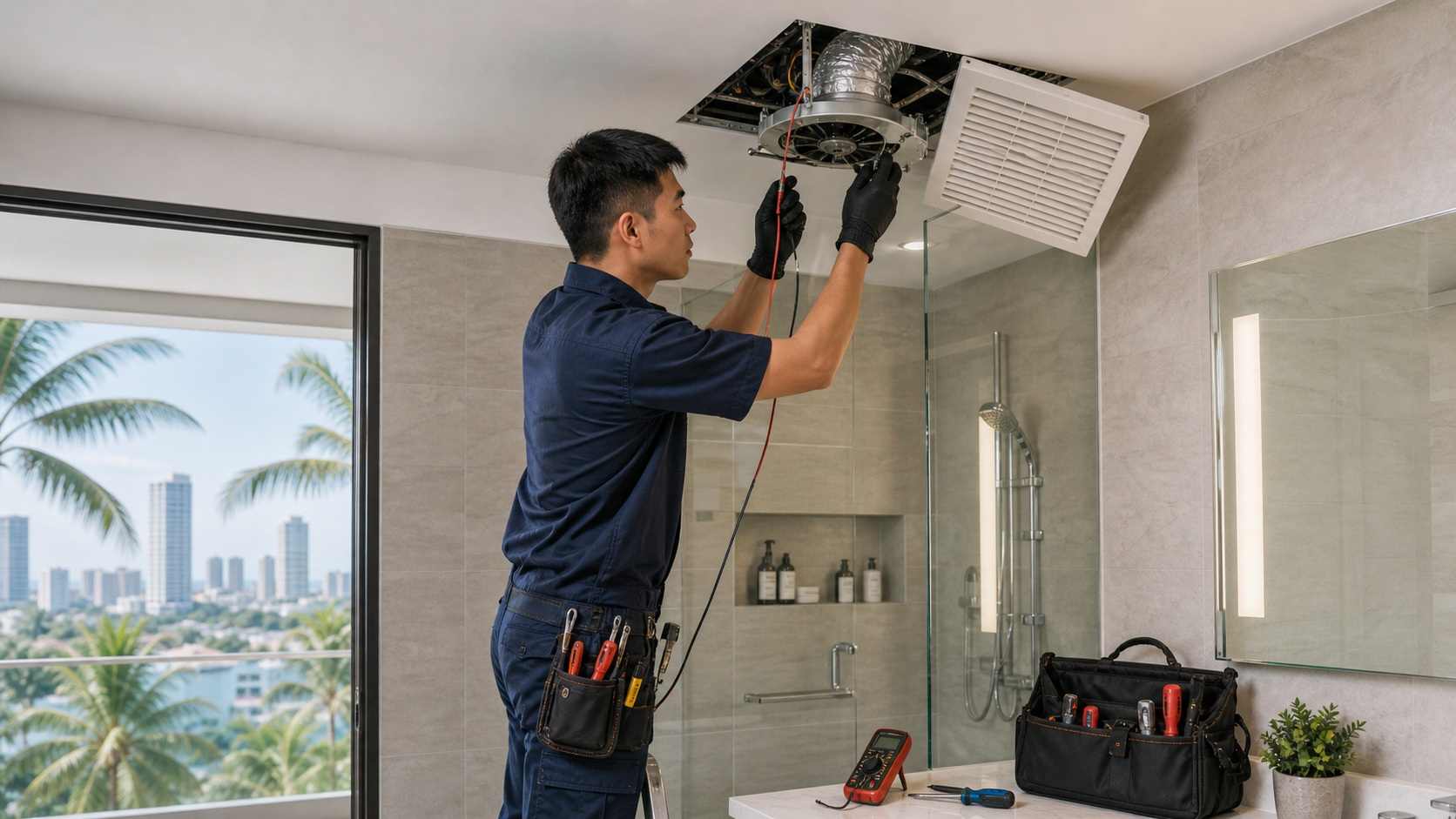
ServiceThai24 diagnoses and repairs exhaust fans and ventilation systems in Pattaya and nearby Chon Buri areas. We assess residential and commercial equipment when a fan does not start, airflow is weak, operation is noisy or the control system is not working correctly.
The fault can be in the electrical supply, switch, motor, impeller, mounting, controller, damper, accessible duct or the overall air path. Send the equipment details and symptom so the appropriate diagnostic scope can be confirmed.
Request ventilation or exhaust fan diagnostics
Send your location, property type, fan or hood model, photos of the equipment and control, and a short video of the sound or vibration if safe. For weak airflow, include where the fan extracts air from and where the duct discharges.
Ventilation equipment we assess
- bathroom and toilet exhaust fans;
- kitchen and utility-area extractor fans;
- wall-mounted and ceiling-mounted fans;
- inline fans connected to accessible ducts;
- kitchen hood extraction within the accessible fan, power and airflow scope;
- technical-room and equipment-room ventilation;
- fans with switches, timers, sensors or speed controls;
- selected residential and commercial ventilation equipment.
Common ventilation and fan problems
- the exhaust fan does not turn on;
- the fan starts intermittently or stops during operation;
- airflow is weak even though the fan is running;
- the fan hums, rattles, scrapes or vibrates;
- the impeller turns slowly or does not reach normal speed;
- the switch, timer, sensor or speed control does not respond;
- a breaker or protective device trips when the fan starts;
- humidity, heat or odour remains in the room;
- air moves in the wrong direction or returns when the fan is off.
How the fault is diagnosed
Diagnosis separates the fan itself from the power supply, control and air path. Depending on access and the symptom, checks may include the supply, switch, connections, controller output, motor response, impeller condition, mounting, damper movement and accessible duct opening.
A running fan is not proof that the complete ventilation system is working correctly. Airflow can remain poor because of obstruction, an unsuitable duct route, a closed damper, restricted discharge or insufficient replacement air entering the room.
Power supply, switches and electrical faults
A fan that does not start may have no supply, a faulty switch, loose connection, damaged cable, failed timer, control fault or internal motor problem. Electrical checks are performed before assuming that the complete fan must be replaced.
If the fault belongs to the building circuit, distribution board, protective device or new wiring requirement, the work is routed to Electrical Repair or Electrical Installation.
Motor, impeller and mechanical condition
Noise, slow rotation and vibration can be caused by contamination, a damaged impeller, worn bearings, loose mounting, contact with the housing or motor deterioration. The equipment is assessed for safe access and serviceability before cleaning, adjustment or replacement is proposed.
Continued operation with severe vibration, overheating, scraping or a burning smell can cause further damage. Switch the equipment off if it is safe and send the symptom details.
Weak airflow and accessible duct checks
Weak extraction can result from a dirty grille, restricted fan, closed backdraft damper, obstruction in an accessible duct section, unsuitable duct dimensions, excessive bends, damaged flexible duct or a blocked exterior outlet.
Inspection is limited by access. Concealed ducts inside walls, ceilings, shafts or neighbouring property areas may require access work, specialist inspection or a separate cleaning scope.
Replacement air and room conditions
An exhaust fan removes air only when replacement air can enter the room. Tight doors, sealed windows or blocked transfer grilles can reduce extraction even when the fan and duct are clear.
Persistent humidity or odour may also involve a moisture source, plumbing leak, air-conditioning condition, building design or insufficient fan capacity. Ventilation diagnostics identifies the observed limitation but does not assume that every humidity or odour problem is caused by the fan.
Noise and vibration diagnostics
The type and timing of a sound help narrow the cause. Rattling may come from a grille, mounting or damper; scraping may indicate impeller contact; humming without rotation may indicate a motor or starting fault; vibration may be transferred through the wall, ceiling or duct.
Send a short video recorded from a safe position. Do not remove a grille or place a hand near a moving impeller to demonstrate the fault.
Bathrooms, kitchens and technical rooms
Bathroom ventilation is assessed around humidity, safe electrical installation, fan condition, air entry and the discharge path. Kitchen extraction may include grease, filters, fan load, duct restrictions and access to the outlet.
Commercial kitchens, long grease ducts, fire dampers and specialist cleaning or certification may require a separate contractor or expanded scope. Technical-room ventilation is reviewed together with the heat source and operating conditions of the installed equipment.
Villas, condos and commercial properties
Villas can have several bathrooms, roof or wall outlets and long concealed routes. Condos may share building shafts and have access restrictions. Restaurants, shops and other businesses may need work planned around operating hours, equipment access and a larger ventilation load.
Property rules, ceiling access, working height and the location of exterior outlets should be provided before the visit where possible.
Timers, sensors and speed controls
Some fans operate through run-on timers, humidity sensors, occupancy controls, speed controllers, relays or smart-home logic. A control fault can imitate a motor or supply fault, so the installed operating sequence must be understood before parts are replaced.
New control or automation requests are assessed separately for compatibility, safe switching and the need for local manual operation.
Cleaning and access limits
Accessible grilles, impellers, housings, filters and short duct sections can be assessed for cleaning after their condition is inspected. The service does not automatically include full deep cleaning of concealed ducts, shafts, roof routes or commercial grease-extraction systems.
Ceiling opening, high-access work, removal of fixed cabinetry or finishes and specialist duct cleaning are clarified before work begins.
Repair or fan replacement
Repair may be appropriate when the fault is accessible and the required part or connection can be serviced safely. Replacement may be considered for a failed sealed motor, damaged housing, unavailable parts, unsuitable capacity or equipment that cannot be accessed economically.
A replacement fan must be checked against the opening, duct connection, airflow requirement, voltage, control method, damp-area conditions, mounting and service access. Matching only the visible grille dimensions is not enough.
Information to send before the visit
- property location and type;
- room or commercial area served by the fan;
- brand, model and rating-label photo if accessible;
- photos of the fan, grille, switch, control and visible duct;
- a description of no power, weak airflow, noise, vibration or control fault;
- whether the problem is constant or intermittent;
- ceiling height, access restrictions and exterior outlet location if known;
- any recent electrical, ceiling, renovation or duct work.
How the service works
- We review the equipment, symptom, access and property information.
- The safe diagnostic scope is confirmed for the fan, power, control and accessible air path.
- Inspection and measurements identify the observed fault or system limitation.
- Repair, cleaning of accessible parts, control work or replacement is discussed.
- Approved work is completed where safety, access, compatibility, tools and parts allow.
- Operation is checked and any remaining duct, building or specialist requirements are reported.
Safety and urgent faults
- switch the fan off if there is a burning smell, smoke, severe overheating or loose rotating parts;
- do not repeatedly reset a breaker or protective device that trips;
- do not reach through a grille or stop an impeller by hand;
- do not open powered controls or work near wet electrical connections;
- keep unstable ladders and improvised access away from ceiling-mounted equipment.
For immediate electrical danger, use Emergency Electrical or Power Outage guidance as appropriate.
Service area
Exhaust fan and ventilation diagnostics are available in Pattaya, Jomtien, Pratumnak, Naklua, Wongamat, Bang Lamung and nearby Chon Buri areas. Send the location, equipment details and access information to confirm the service scope.